The Finished-Object Trap: Why a Group Project Need Not Match
A neighbourhood group project can feel coherent without matching pieces. Use a shared display plan, clear ownership and simple boundaries to bring contributions together.
How can a neighbourhood group project feel like one shared effort when nobody’s work matches? A neighbourhood group project can connect contributions through how they are arranged, labelled and cared for, rather than asking everyone to make the same thing.
That distinction matters when the finished work will be displayed in a library, community hall or shop window. A group may need a practical plan for fitting contributions into one place, but visual uniformity is only one way to create a sense of connection. Clear boundaries, thoughtful arrangement and agreement about ownership can do the joining instead.
Plan the shared display before anyone makes
Start with the place the work will occupy. Is it a wall, a table or a window ledge? Decide what the site can accommodate, how viewers will encounter the work and who can approve its placement. These choices shape useful practical limits without dictating what participants should make.
For a wall display, for instance, the group might agree that contributions need to be light enough for the chosen display method and have a clear place for a name or optional title. For a table, pieces may need to stand securely or lie flat. Confirm those requirements with the venue rather than assuming its surfaces, fixings or permissions are available.
Keep the boundary list short and explain the reason for each rule. A limit about fragile objects may protect work from being handled; a rule about wet materials may suit a room used by other groups. If there is no practical reason to standardise a feature, leave it to the maker.
Use display choices to connect varied work
A repeated element around the work can provide visual structure without changing the contributions themselves. Consider a common backing board, a consistent label style, a shared border around the display or a title placed nearby. Choose one or two devices that suit the venue; too many can compete with the work.
Arrangement matters as much as framing. Put pieces in conversation: a handwritten observation might sit beside an object that relates to the same place, while a larger contribution can anchor a cluster of smaller ones. Ask makers if their work has a preferred neighbour or orientation. That small conversation can reveal connections organisers would miss.
Resist placing an unusual piece at the edge simply because it stands out. If it meets the agreed practical conditions, give it a position where viewers can notice it. The aim is not to make each item blend in, but to help people see how the collection belongs together.
Make permissions, labels and ownership clear
Before work begins, tell participants where contributions may be shown, for how long, and whether photographs might be taken or shared. Ask for permission rather than treating attendance as consent. If the venue has its own display rules, pass those on in plain language.
Agree how names will appear. Some makers may want a full name, others a first name or no attribution. A simple label can include a chosen name and a short title, but neither should be compulsory unless the venue has a specific requirement. Keep labels readable and separate them from the work when attaching them could cause damage.
Ownership deserves the same clarity. Say whether each maker keeps their contribution, lends it for a display period or gives it to the group. Explain how people can identify and collect their work afterwards. If the group hopes to keep pieces together, discuss that before anyone starts making them.
Use a short preparation list to prevent display surprises
- Check the venue’s permission and display rules; if the arrangement is approved, share them with participants, and if it is not, choose another site or revise the plan.
- Check the available surface and fixing method; if each contribution can be placed securely, proceed with that method, and if not, choose a safer display format with the venue.
- Check whether labels are required; if they are, agree a simple format and offer attribution choices where possible, and if they are not, use a shared title or a brief note instead.
- Check what participants have agreed about photographs; if permission is clear, follow its limits, and if it is absent or uncertain, do not photograph or share the work.
- Check who owns each contribution; if the maker intends to collect it, record how and when it will be returned, and if ownership is unsettled, ask before displaying it.
- Check whether any item is fragile, wet or difficult to secure; if it suits the agreed conditions, include it, and if not, discuss a suitable alternative display method with its maker.
Imagine a library display with mixed contributions
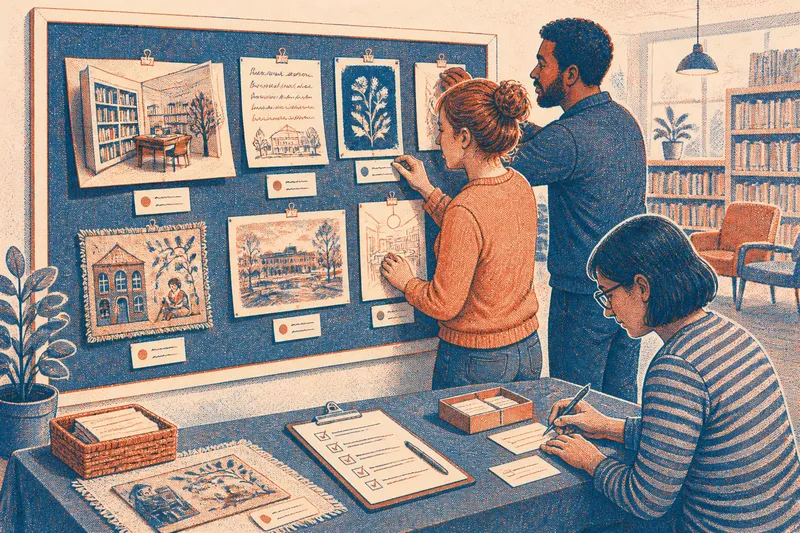
Imagine a neighbourhood group has invited people to contribute small pieces about a local library. The venue offers a noticeboard and asks for work that can be displayed without damaging the wall; these are invented details for this example. The organiser first confirms that the board is available, asks what fixing methods are permitted, and tells participants that contributions will be displayed temporarily and returned to their makers.
One participant brings a folded paper scene, another offers a handwritten memory on card, and a third brings a small fabric piece. The organiser checks each contribution against the venue’s rules, then finds that the fabric cannot be attached securely using the approved method. Rather than asking its maker to change its appearance, the organiser asks whether it may sit on a nearby table, subject to the library’s approval.
The group uses matching labels and a single display title, while leaving the pieces themselves untouched. The fabric piece is placed on the table only after the library agrees; if the table is unavailable, the organiser would ask the maker to choose another suitable option or leave that contribution out of this display. The resulting arrangement gives viewers a clear point of connection while keeping the practical decision visible and respectful.
How can organisers make a display fair and manageable?
How do you arrange work without ranking it?
Use a layout that gives each contribution room to be seen, and invite makers to comment on placement. If space is tight, discuss the constraint openly and consider rotating work rather than quietly sidelining a piece.
Should every contribution have a label?
Not always. A shared title may be enough to explain the collection, while individual labels can help viewers understand particular pieces. Ask makers what attribution they prefer and avoid attaching labels in a way that could harm their work.
What should happen if a contribution does not suit the venue?
Explain the specific practical issue and ask the maker about alternatives, such as a different position or display method. If no option meets the venue’s rules, leave the piece out of that display rather than asking for an unrelated stylistic change.
How should the group handle work after the display ends?
Tell makers in advance when and how contributions can be collected, and keep a simple record of who brought each item. If a maker cannot collect their work, agree on another arrangement with them instead of assuming the group may keep or discard it.
Keep the project coherent through care and coordination
When planning a neighbourhood group project, decide what must be shared: perhaps the display title, the way contributions are labelled or the agreed arrangements for returning them. Let makers retain control of the rest. That approach keeps the project organised while leaving room for work that differs in form, tone and meaning.
Before opening the display, walk through it as a visitor would. Check that the connection is easy to understand, labels can be read, and each contribution is treated according to its maker’s wishes. A few careful choices at this stage can make the collection feel genuinely shared without making the pieces match.