A First-Day-of-Spring Gathering Built Around a Neighbourhood Map
A neighbourhood map gathering turns local memories and hopes into a shared spring activity, with simple prompts that help every neighbour take part.
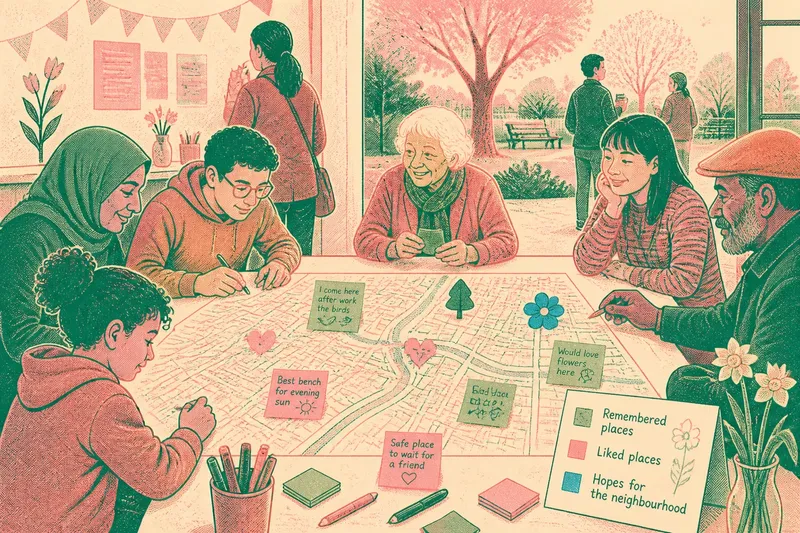
What could make a first-day-of-spring gathering feel like it belongs to the whole neighbourhood? A neighbourhood map gathering gives people a simple answer: invite them to mark a place they remember, enjoy or hope to see, and let the map become the work everyone makes together.
The point is not to produce a polished directory or settle what the neighbourhood should become. It is to create a welcoming occasion where local knowledge can sit side by side: a shortcut someone uses on the school run, a bench that catches the evening sun, or a corner where someone would love to see flowers. Spring offers a natural reason to look at familiar streets with fresh attention.
Make the map a shared conversation
A map can give a gathering a common focus without asking everyone to make the same kind of contribution. One neighbour may draw a tiny tree; another may write a sentence about a place; someone else may listen, point, or help place a note. Each is a valid way to participate.
That variety matters. A person who is shy about drawing can add a written memory. Someone who does not know the area well can mark a place they hope to discover. A child might choose a favourite puddle or a safe spot to wait for a friend. The map collects these different ways of noticing rather than testing anyone’s local expertise.
Keep the invitation open-ended but bounded. Ask for a remembered, liked or hoped-for place, not an account of every local issue or a promise to fix one. That keeps the gathering centred on shared attention, while leaving room for the map to reveal what matters to people.
Choose a map that invites marks
Use a large printed street map, a hand-drawn outline, or a simple map assembled from paper. The best choice is the one people can read from where they sit and mark without worrying about spoiling it. A library, community centre or neighbourhood group may have access to a printer or a suitable map; check that the source is appropriate for public display.
For a hand-drawn version, include enough landmarks for orientation: main roads, a park, a library, a river or other recognisable features. Leave clear space around the edges for a key and notes. Avoid filling the map with tiny labels; if people have to lean close just to locate their street, they may hesitate to join in.
Put out sticky notes, broad felt-tip pens, coloured pencils and a few small paper shapes. Sticky notes let people revise or move a contribution, while pens and pencils offer different ways to mark. Choose a few colours with a simple key—for instance, one for remembered places, one for liked places and one for hopes. Explain that the colours are prompts, not rules.
Set up the gathering so people can join at their own pace
Place the map where it can be approached from more than one side, with chairs nearby for anyone who would rather sit. Keep the materials within easy reach and leave room for coats, cups and mobility aids. A community room, sheltered courtyard or library meeting space can work; choose somewhere people can find and enter comfortably.
At the entrance, offer a brief invitation: “Mark a place you remember, enjoy or hope for.” A small sign can repeat it. Rather than giving a long introduction, show one sample mark on a separate scrap of paper, so visitors can see how little is required without mistaking the sample for a real contribution.
Let people arrive, look around and decide whether to add something. A host can welcome newcomers, explain the colour key and help locate a street, but should not steer people towards particular places. If conversation starts naturally, make room for it; if someone prefers to mark the map quietly, that should feel equally welcome.
Use prompts that make local knowledge easy to share
Prompts work best when they lead to a place, not a perfect story. Try questions such as:
- Where do you pause for a moment on an ordinary day?
- Which place reminds you of a season or a neighbourly occasion?
- Is there a spot you would like to explore or improve together?
- Where do you feel connected to this neighbourhood?
People can answer with a word, a symbol or a short note. If a contribution needs context, invite its maker to add one sentence, or offer to write it down with their permission. Do not assume that a blank-looking mark means someone has nothing to say; they may simply prefer not to explain it aloud.
Say you are hosting in a community room beside a small park. One neighbour places a green note on the park entrance and writes, “I come here after work to hear the birds.” Another adds a blue paper flower to a nearby street with the hope of planting something there. The map now holds a present-day pleasure and a future wish, without requiring either person to make a speech or take on a project.
Keep the map welcoming and respectful
Not every place or memory needs to be named publicly. Ask people to avoid adding private addresses, personal details about someone else, or notes that single out a neighbour. If a contribution raises a sensitive concern, offer a separate way to speak with the organiser rather than putting it on display. This protects the gathering from becoming a public noticeboard for matters that need more care.
Make clear that people may leave a note anonymous, move their own mark, or choose not to contribute. If the map will be photographed, shared online or kept on display afterwards, explain that before people add anything and ask permission where appropriate. A map that feels safe to approach is more useful than one packed with marks.
When people disagree about a place, do not turn the map into a vote. Two neighbours can mark the same area from different perspectives. That difference is part of the map’s value: it shows that a shared neighbourhood is not experienced in only one way.
Let the gathering end with a useful next move
As the event winds down, invite a few people to look over the map together. Ask what surprised them, what they would like to learn more about, or whether one small idea feels worth carrying forward. Keep this optional; the map is already a complete piece of shared work even if nobody volunteers for a follow-up.
If the group does choose a next move, make it modest and specific: perhaps a walk to visit a marked place, a conversation with a local organisation, or a small springtime meet-up. Record who wants to hear more, rather than treating a hopeful mark as a commitment. For any planned public activity or change to a shared space, check the relevant permissions and local arrangements before proceeding.
Display the map for a short period if the venue allows, with a note explaining what the marks mean and how people can add a thought later. If it is taken down, tell contributors what will happen to it. The map can be kept, returned to its makers or photographed with their agreement; choose a course that respects what people were told at the start.
Questions neighbours may ask before joining
Do I need to be good at drawing?
No. A dot, a sticky note, a word or a spoken suggestion is enough. The activity is about sharing a place, not making a beautiful map.
What if I have only just moved here?
You can mark somewhere you have noticed, somewhere you want to visit, or a place that helps you feel at home. Curiosity is a useful contribution, too.
Can children add to the map?
Yes, with prompts suited to them, such as a favourite route or a place where they like to play. Have an adult help with labels or any detail a child would rather dictate.
What if we cannot agree on what a place means?
Let more than one note sit nearby, or invite each person to mark the place from their own perspective. The map records different experiences; it does not need to resolve them.
A neighbourhood map gathering works because its central object remains open to everyone’s contribution. The first-day-of-spring map can hold a fond memory, a small pleasure and a hopeful idea without asking them to become the same thing. If you repeat the activity, keep the neighbourhood map gathering centred on those local voices, and let the next season bring its own places into view.